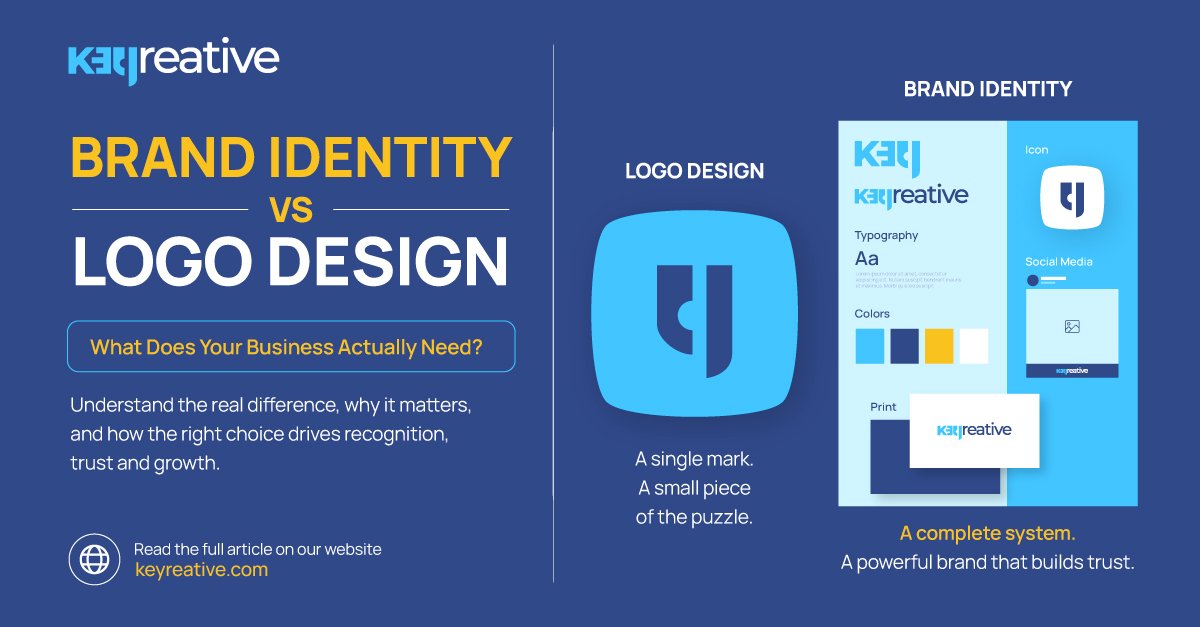
A business rarely wakes up thinking, “We need a brand identity.” Usually, the conversation starts much smaller: “We need a better logo,” or “We have a logo, but nothing we create looks consistent.”
That last problem is where the distinction starts to matter. A logo can identify your business. A brand identity gives that logo a world to live in. Depending on where your business is today, you may genuinely need only one of them.
The mistake is not choosing a logo instead of a full identity. The mistake is paying for one thing while expecting it to solve the problems of the other.
First, what is a logo?
A logo is the visual mark used to identify your business. It might be a symbol, a wordmark, initials, a combination mark or something more abstract. Its job is focused: help people recognise who they are looking at.
Think about the logo on your website header, social profile, invoice, storefront or product. It is an identifier. A good logo should be distinctive, appropriate, flexible at different sizes and recognisable across applications.
But it cannot do every job your business needs. A logo does not decide what your social posts should look like, which photographs belong on your website, what presentation template your sales team should use, how headlines should behave or how your brand should feel when someone opens your website. That is where brand identity begins.
So what is a brand identity?
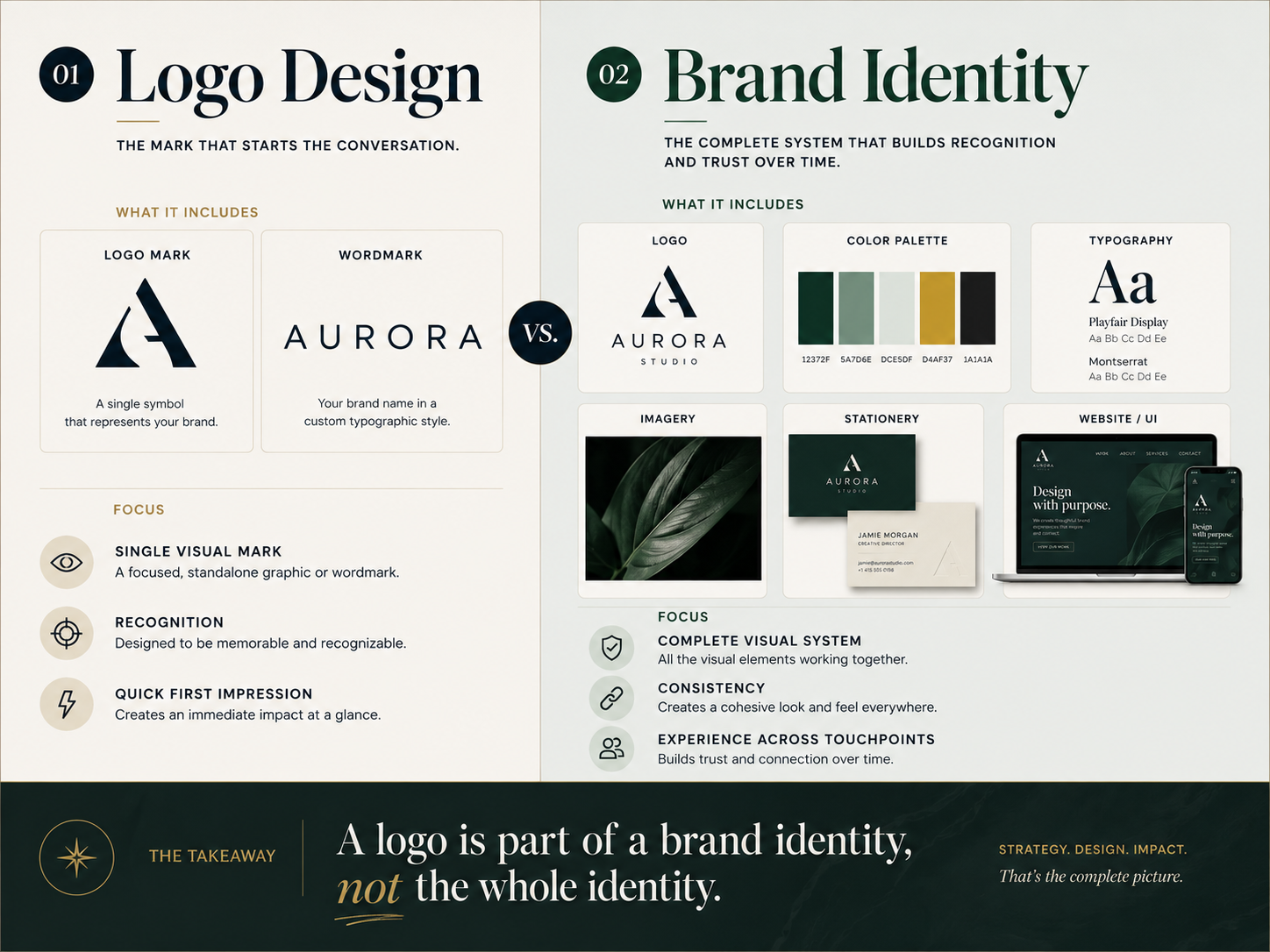
Brand identity is the visual and verbal system that surrounds the logo and creates consistency across the entire business. The logo is one component of that system.
Depending on the company, an identity may include colour, typography, imagery direction, graphic elements, iconography, layouts, templates, digital design language, tone of voice and the rules that determine how all of those elements work together.
A strong identity answers questions before your team has to ask them: What colour should this presentation use? What typeface belongs on the website? How should photography be treated? Should the brand feel restrained, energetic, technical, luxurious or approachable?
The simplest way to understand the difference
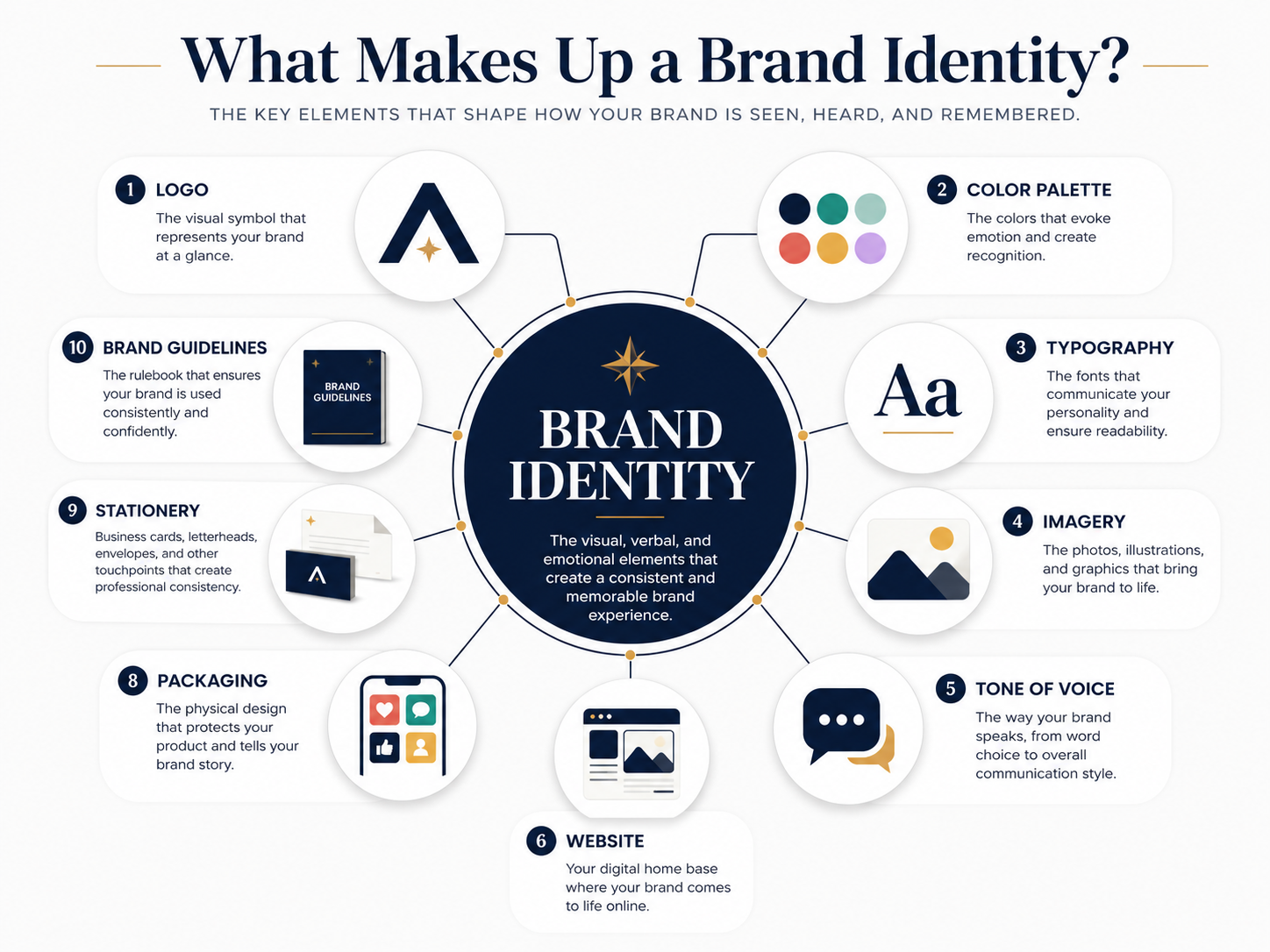
A logo is like your signature. A brand identity is everything that makes the document recognisably yours before someone even reaches the signature.
| Logo design | Brand identity |
|---|---|
| Identifies the business | Shapes how the business is perceived |
| Usually one core visual asset | A complete visual system |
| Creates recognition | Creates recognition and consistency |
| Works as a mark | Works across multiple touchpoints |
| Solves an identification problem | Solves a communication problem |
Neither is automatically better. They solve different problems.
When a logo may genuinely be enough
Not every new business needs an extensive brand identity on day one. If you are validating an idea, launching something small or operating with only a handful of customer touchpoints, a strong logo may be enough to get started.
Imagine a solo consultant who needs a simple website, LinkedIn presence and proposal document. There may be little reason to build a complex system containing dozens of templates and applications.
The useful question is not “Can we afford a full brand identity?” It is: How many places does this brand need to show up, and how consistent do those places need to be?
When a logo stops being enough
You usually start needing a proper identity when the business is represented in many places at once. Your website looks one way, your sales presentation another, social uses different fonts, the company profile uses colours that were never defined and a developer needs button colours.
Now the problem is no longer the logo. The business has no shared visual language. This is often why established companies say their branding feels messy even when there is nothing technically wrong with the logo itself.
Consistency is where identity becomes valuable
Branding is partly about memory. People might first encounter you through a LinkedIn post, then visit your website, see an advertisement, receive a proposal and eventually speak to your team. Those moments should feel connected.
When every touchpoint uses different rules, customers rebuild their impression of the company every time. When the identity is consistent, recognition compounds. Colour, typography, imagery and layout begin to signal the company before the customer even sees the logo.
A great logo cannot rescue a weak experience
A company feels outdated, so it redesigns the logo. The new logo launches, but the website still has weak messaging, the sales deck remains disconnected, social has no consistency and the photography still feels random. Only the symbol changed.
If the real problem is inconsistency, poor presentation or weak positioning, changing the mark alone will not solve it. A logo redesign should sometimes be part of a larger identity change, not the entire change.
What does a complete brand identity usually include?
There is no universal package every company needs. A photography studio, law firm, landscaping company and technology business should not receive identical deliverables. The system should be built around how the business actually communicates.
A practical identity may cover the logo system, typography, colour palette, image direction, graphic language, layout principles, social applications, stationery, digital applications and brand guidelines. The value is not the number of files delivered. It is whether the components give the company enough structure to create consistently after the project is finished.
Explore how Keyreative approaches brand identity systems and graphic design.
Brand identity is not the same as branding
Your brand identity is not your entire brand. Your brand also includes reputation, customer experience, positioning, messaging, product quality, pricing, behaviour and what people ultimately believe about the company.
Design can influence that perception. It cannot completely control it. Good branding aligns how the business presents itself with the experience it is capable of delivering.
How do you know what your business actually needs?
Ask a practical question: Where will this identity need to work over the next 12 to 24 months?
If the answer is one website and a business card, you may not need an elaborate system. If it includes advertising, social media, presentations, proposals, packaging, signage, printed material, multiple team members and several marketing channels, you probably need much more than a logo.
You probably need only a logo if…
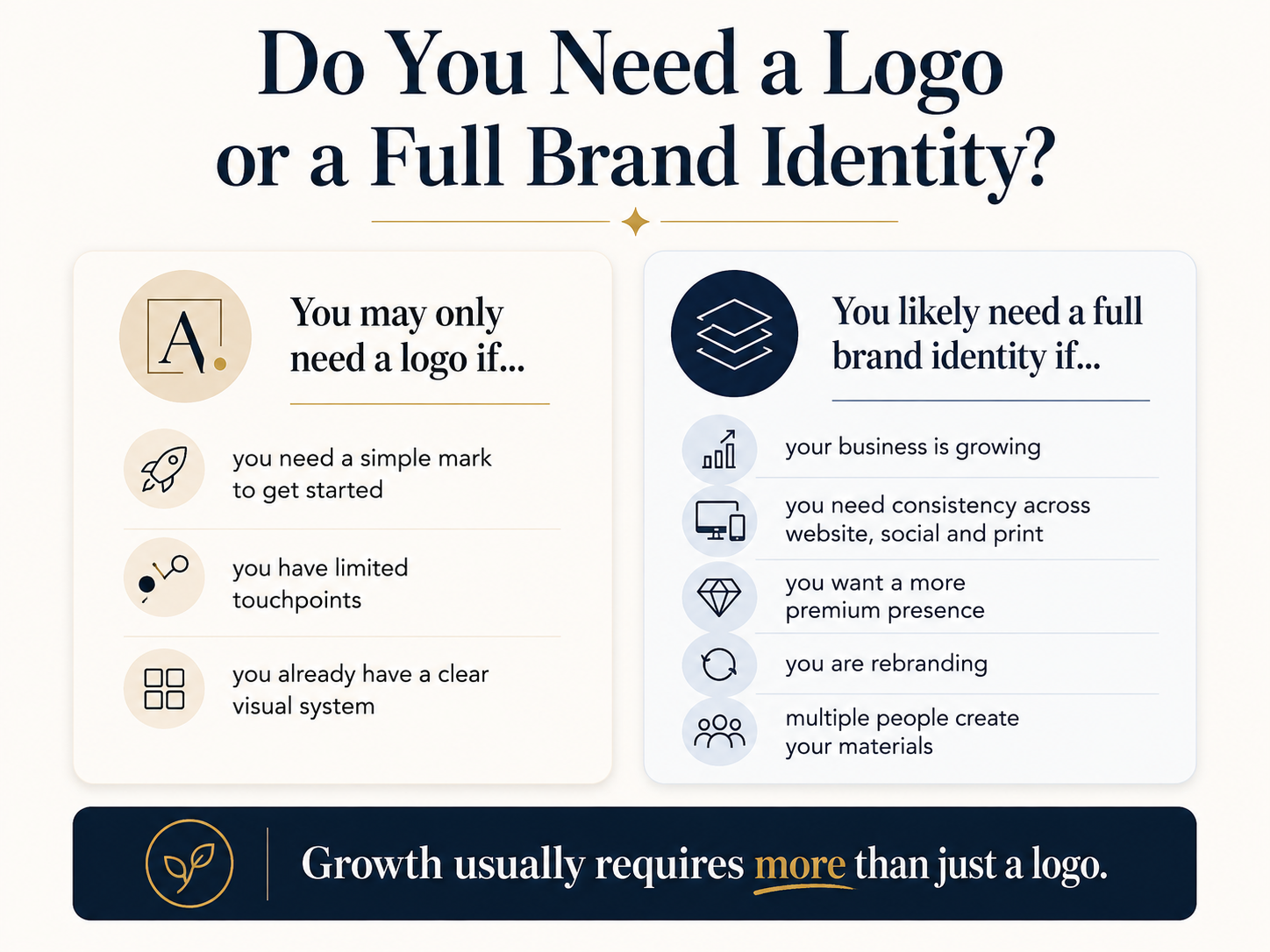
You are at a very early stage, your customer touchpoints are limited, you already have clear visual rules or you simply need a professional mark before validating the larger business. Starting lean can be sensible.
You probably need a full identity if…
Your business is growing, multiple people create branded materials, your website and marketing feel disconnected, you are moving into a more competitive market, your current presentation no longer reflects the company or you are repositioning.
This matters especially for service companies. Before a customer can evaluate the quality of your legal work, photography, landscaping, construction, consulting or property services, they often evaluate how credible the business appears.
What about startups?
Startups sit somewhere in the middle. Building too much too early can waste money. Building too little can create unnecessary redesign work six months later. The best approach is often a scalable identity: establish the fundamentals properly while avoiding applications the business does not yet need.
And what about established businesses?
For established businesses, the question is often not “logo or identity?” It is: How much of the current identity should we keep?
Recognition has value. Sometimes the strongest rebrand is evolutionary: keep what still works, remove what no longer does, refine the system, introduce consistency and modernise the applications.
The most expensive option is often inconsistency
Inconsistency creates costs. Teams repeatedly decide how materials should look. Designers recreate assets. Marketing becomes slower. Developers make visual decisions that should already have been made. Different vendors interpret the brand differently.
A good identity reduces those decisions and gives the business a shared visual framework. That is why identity becomes more valuable as organisations become larger and more complicated.
So, logo or brand identity?
If you simply need a recognisable mark, start with a logo. If you need your business to communicate consistently across multiple channels, you need an identity. If customers do not understand what makes your company different, you may need to go deeper into strategy and positioning before either design process begins.
Do not buy a logo expecting an entire brand. Do not buy a huge identity system when your business only needs a strong foundation. Build what the company needs today, but design it so it can still make sense tomorrow.